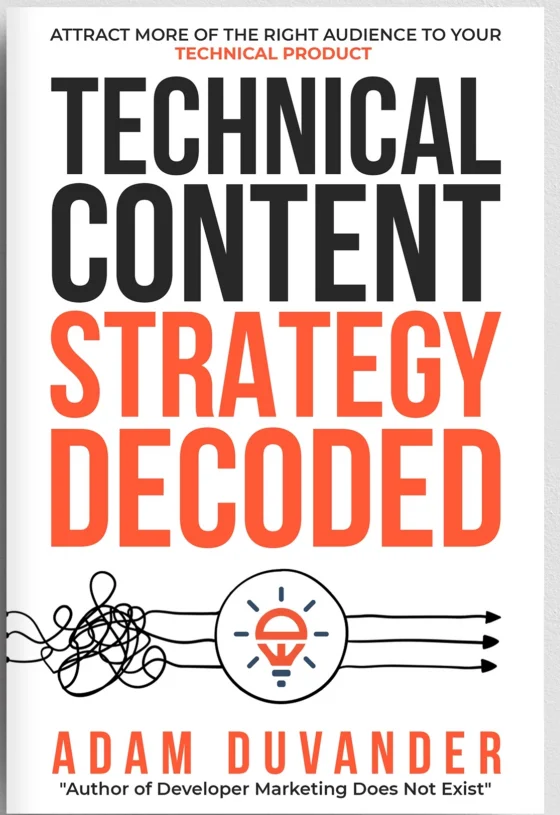
Technical Content Strategy Decoded
Attract More of the Right Audience to Your Technical Product.
Book read onTechnical Content Strategy Decoded by Adam Duvander is the follow-up to Developer Marketing Does Not Exist, and it narrows the focus from developer marketing in general to one thing: the content you publish and why it does or does not attract the right technical audience. Its answer is consistent from the first page to the last: the job of technical content is to teach. It is a short book. I read it in one evening, and by the end I had a clear picture of its main concepts, which is exactly what a book like this should deliver.
The starting point will be familiar to anyone who read the first book: be a teacher, not a marketer. Your job is to educate your audience about the problem space, not to sell them the product. This is the single idea I took away most strongly, and everything else in the book is a consequence of it. A teacher has to know who is sitting in the room, so you need to understand your audience. A teacher has to speak the language of the students, so you learn the common language they use to describe their problems and use it instead of your internal product vocabulary. And a teacher acts as a translator between what the audience already knows and what your product can do for them. The book also catalogs the common mistakes people make in that translator role, which is a useful checklist to hold your own content against.
The core of the book is what Duvander calls the technical engagement system, three dials summarized as P.A.T.: Problem, Angle, Teach. Every piece of content starts from a problem your audience is having, takes a specific angle on it, and then teaches the solution, with your product appearing only as part of what is being taught. The third dial is where the teacher mindset from the opening chapters becomes a concrete step in producing each piece. This ordering is the whole point. People search for solutions to their problems, not for your product, so content that leads with the product is invisible to the people you most want to reach.
From there the book gets practical about establishing a concept catalog: a curated set of the concepts your audience needs to understand, which becomes the backbone of your content plan. Instead of chasing whatever topic seems interesting this week, you build authority around a defined set of concepts and let individual articles hang off them. I liked this because it turns content strategy from an ad hoc activity into something you can actually plan and maintain.
Duvander also spends time on what matters and what does not. Excessive SEO tactics, vanity metrics, and volume for its own sake fall into the second category. The numbers most people track are, in his view, the wrong ones, and the book is direct about which ones actually matter.
One thing I missed is the breakdown of content types that made the first book so practical. Developer Marketing Does Not Exist separated blog posts, tutorials, and guides, described what each one is for, and even prescribed a structure for a good tutorial. This book operates one level above that. It tells you which problems and concepts to write about, but not which form the resulting piece should take. Having that mapping here, from concept catalog entry to blog post, tutorial, or guide, would have closed the loop. If you have not read the first book, keep that gap in mind; if you have, you can supply the missing piece yourself.
Verdict: A compact, focused book that you can read in one sitting and put to use the next day. If you remember one thing from it, remember to teach. It goes deeper on strategy than Developer Marketing Does Not Exist, but it leans on that book for the content types and their structure, so read the two together. Recommended for anyone writing technical content for a product they want people to find.